Technology, Properties, and Applications
In Brief
- Technology: Liquid crystals in polymer matrix – PDLC film with light-scattering or light-transmitting effect.
- Switchable Transparency: Switchable between opaque and transparent via electrical voltage.
- Applications: Architecture, Automotive, Medical Technology, Advertising.
- Advantages & Limitations: Silent, retrofittable, but with slightly hazy transparency and not UV-resistant.
⏱ Estimated Reading Time: 3 Minutes
PDLC stands for “Polymer Dispersed Liquid Crystal” and describes an electrochromic technology based on the dispersion of liquid crystals within a polymer. This technology enables the production of materials that can be switched between a transparent and a light-scattering (opaque) state. PDLC finds widespread application, particularly in what are known as “Smart Windows” or “Smart Glass.”
A PDLC film typically consists of two transparent substrates, such as glass or plastic film, between which a layer of polymer matrix is embedded, containing microscopically small liquid crystal droplets dispersed within it. This layer is usually only a few micrometers thick. In the unpowered state, the liquid crystals are disordered, causing incident light to be scattered and the film to appear opaque. When an electrical voltage is applied, the liquid crystals align along the electric field, allowing light to pass almost unimpeded, and the film becomes transparent.
Technical Specifications of PDLC
- Switching Voltage: 30 – 100 V AC
- Response Time: 10 – 100 ms
- Light Transmission: up to 85% (transparent)
- Power Consumption: approx. 3 – 6 W/m² in the ON state
- Operating Temperature Range: –20 to +60 °C
Key advantages of PDLC include:
- Switchability between transparent and opaque
- On-demand privacy protection
- Blocking of UV and IR radiation
- No mechanical components: silent and low-maintenance
- Retrofittable into existing glazing systems
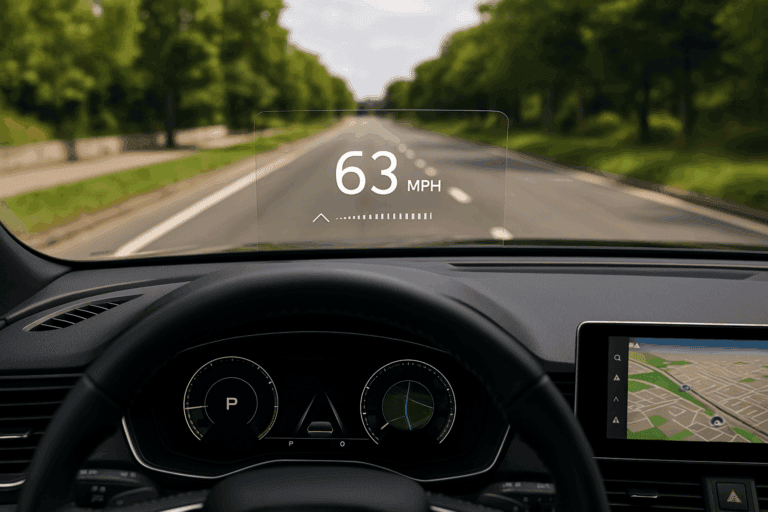
PDLC technology can be applied in numerous fields. In architecture, these films are used as switchable glazing in conference rooms, partitions in bathrooms, or facade glazing. They can also be used as rear projection screens for projectors. In automotive manufacturing, they serve as partition screens or privacy windows. PDLC is also prevalent in medical technology, for example in treatment rooms, as well as in design and advertising (e.g., as projection surfaces or interactive displays). The costs for PDLC films have significantly decreased in recent years.
However, there are also limitations: The maximum transparency in the ON state is not comparable to conventional glass, as a slight haze persists. Long-term UV exposure can lead to the degradation of the PDLC layer.
Conclusion
PDLC is a forward-looking technology for realizing switchable glazing. It offers flexible control options for light transmission and privacy, and its application is increasing in architecture and automotive manufacturing, even though technical and economic challenges remain.