
The next evolutionary stage of energy-efficient displays
In Brief
- Adaptive E-Paper Driving takes standard e-paper to a new level of performance —with up to 16 shades of gray, faster updates, and optimized energy efficiency, all without additional hardware.
- The technology dynamically generates waveforms in real time, enabling even low-cost 2-bit controllers to achieve functions that were previously only possible with external controllers.
- Ideal for signage, industry, and IoT: higher image quality, flexible update modes, and lower BoM costs enable new applications for energy-efficient e-paper displays.
⏱ Estimated reading time: 6-8 minutes
Introduction: Why new e-paper technology is needed
E-paper displays offer excellent readability, extremely low energy consumption, and a long service life. Nevertheless, they are often still underutilized in dynamic information systems due to:
- limited grayscale depth
- slow updates
- rigid, manufacturer-based waveforms
- additional hardware costs for higher quality
Adaptive E-Paper Driving demonstrates that all these limitations can be overcome using software alone.
The innovation: dynamically generated driving waveforms in real time
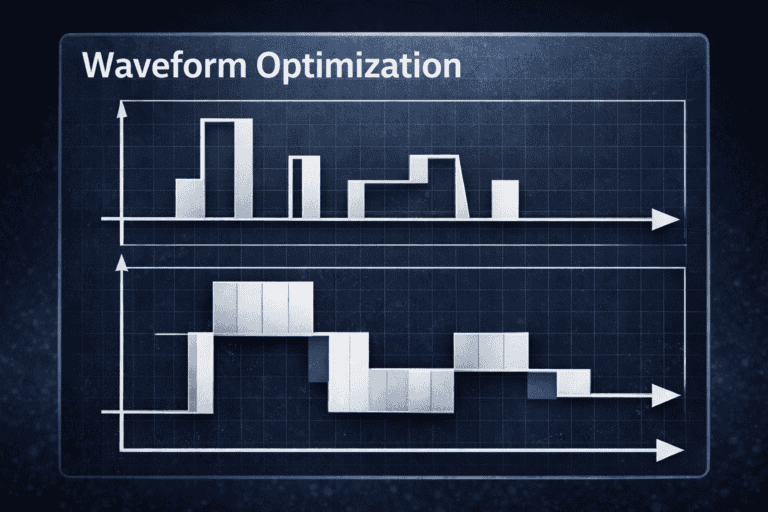
At the heart of the technology is the real-time calculation of driving waveforms (LUTs). These are no longer loaded as static tables, but are generated individually for each image update.
What makes this technology unique?
- Real-time calculation of optimized waveforms
- Adjustment of timing, pulses, and voltage parameters during each update
- High-performance rendering on low-cost 2-bit controllers
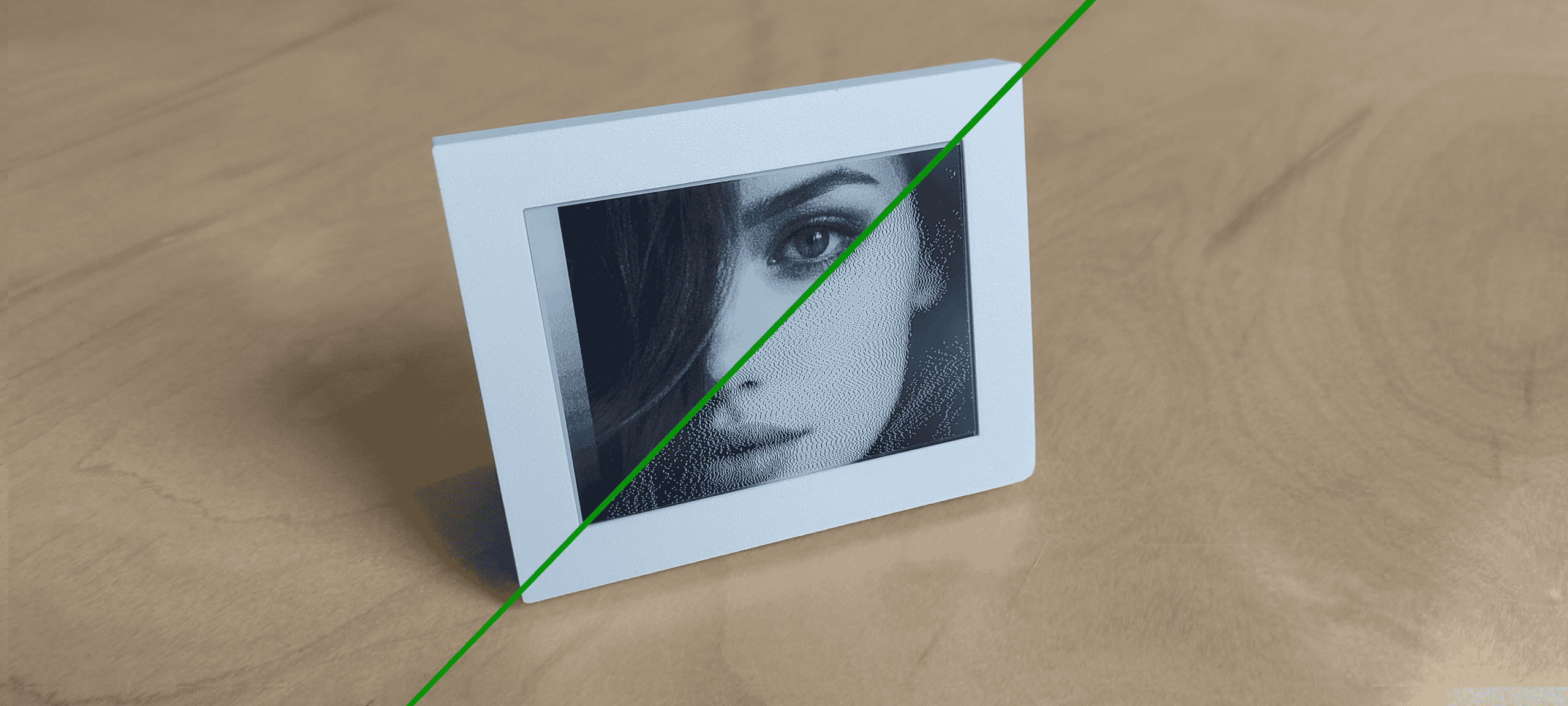
- Up to 16 shades of gray on original black-and-white displays
- Reduced ghosting through optimized pixel movements
- Safe operation through controlled electrical load
This allows an inexpensive controller to perform functions that were previously only possible with expensive external controllers.
Practical benefits: Higher image quality on standard e-paper
The key innovation of Adaptive E‑Paper Driving lies in its ability to generate driving waveforms dynamically during each individual image update, rather than using them as rigid, manufacturer-defined tables. This approach differs fundamentally from previous systems, which are based on fixed LUTs and are therefore inherently limited in terms of both image quality and flexibility.
An intelligent algorithm that reevaluates timing, voltage, pulse sequences, and transitions in the millisecond range allows even simple, low-cost 2-bit controllers to be upgraded to high-performance display units. The technology enables up to 16 clearly definable gray scales on panels that were originally designed for black-and-white display only. At the same time, ghosting effects are minimized and the electrical stress on the panel structure is controlled, which supports the service life of the display. All these improvements are purely software-based and do not require any additional hardware components.
Adaptive E-Paper Driving is thus bringing about a paradigm shift: cost-sensitive standard modules are being transformed into displays that dynamically adapt to application scenarios—whether for highly detailed renderings, fast updates, or energy-optimized operation.
sustainability benefits
Practical application immediately demonstrates how much the visual performance of a classic e-paper panel can be enhanced by adaptive control. On a standard 4.2-inch monochrome display, image details are significantly finer, contours appear sharper, and even complex graphics can be displayed with up to 16 differentiated gray scales. The result is an image quality that would not have been possible with the original hardware.
The flexibility of the update modes is particularly impressive. Depending on requirements, the system can be configured for high speed—ideal for dynamic content, status indicators, or changing data—or for maximum precision and image depth for high-quality static displays. At the same time, energy consumption remains extremely low, as the software control makes the refresh process more efficient than conventional controller logic.
For applications in digital signage, industrial displays, or the IoT, this means new freedom: high-quality display, fast response time, and durable hardware—all without additional electronic components and without an increase in BoM costs.
Adaptive e-paper in comparison with competitors
| Feature | Adaptive E-Paper Driving | Market standard |
|---|---|---|
| Required hardware | No additional modules | External LUT controllers / FPGA |
| Cost | Very low BoM | Increased material costs |
| Flexibility | Real-time LUT generation | Static manufacturer LUTs |
| grayscale | Up to 16 | 2–4 |
| update speed | Dynamically optimizable | Fixed refresh cycles |
| energy consumption | Software-optimized | Controller-dependent |
| Customizability | High (temperature, speed, power, grayscale) | Low |

Next steps in development
The platform is continuously being expanded. Planned steps are:
1. Advanced temperature compensation: Consistent image quality across wider temperature ranges.
2. Support for multicolor e-paper displays: Optimized color representation, less ghosting, better stability.
3. Hybrid update mode: Combination of ultra-fast partial updates and high-resolution grayscale areas.
4. Production-ready reference platform: Standardized interfaces, API, and evaluation kits.

FAQ
Adaptive E-Paper Driving is a software-based approach to dynamically generating driving waveforms (LUTs) for e-paper displays. Unlike static, manufacturer-defined tables, the waveforms are calculated in real time and adapted to the respective image or application situation.
No. All performance improvements—higher grayscale depth, faster updates, lower energy consumption—are achieved via software. The existing low-cost controllers continue to be used in their entirety.
Currently, up to 16 clear gray scales are possible on classic monochrome displays—even on panels that originally only supported two scales.
The technology is particularly suitable for digital signage, industrial user interfaces, IoT devices, retail labeling, and applications that require energy-efficient yet flexible displays.
Very simple. Since no additional electronics are required and adjustments are made via software, Adaptive E-Paper Driving can be easily integrated into existing architectures. Parameters for temperature, speed, or energy consumption can be flexibly adjusted.