The Invisible Key to E-Paper Display Performance
In Brief
- Waveforms govern the efficiency and reliability of E-Paper displays, particularly in cold temperatures and during rapid updates.
- LCD Microelectronics optimizes waveforms for wide-temperature applications, color displays, and high refresh rates
- Customized drive schemes improve image quality, reduce ghosting, and enable energy-efficient systems.
⏏ Estimated Reading Time: 4 Minutes
E-Paper displays are the ideal choice for many applications: they are power-efficient, eye-friendly, perfectly legible in sunlight – and retain their image even without power. However, these advantages are based on a technology that operates in the background and is often underestimated: the so-called waveforms.
The development and optimization of these signal profiles represent a crucial part of system expertise. They determine how reliably, quickly, and artifact-free an E-Ink display operates – especially under demanding conditions such as low temperatures, frequent partial image updates, or with color displays. This is precisely where E-Paper technology leverages its strengths – provided that the waveforms are perfectly matched to the respective system.
What Exactly Are Waveforms?
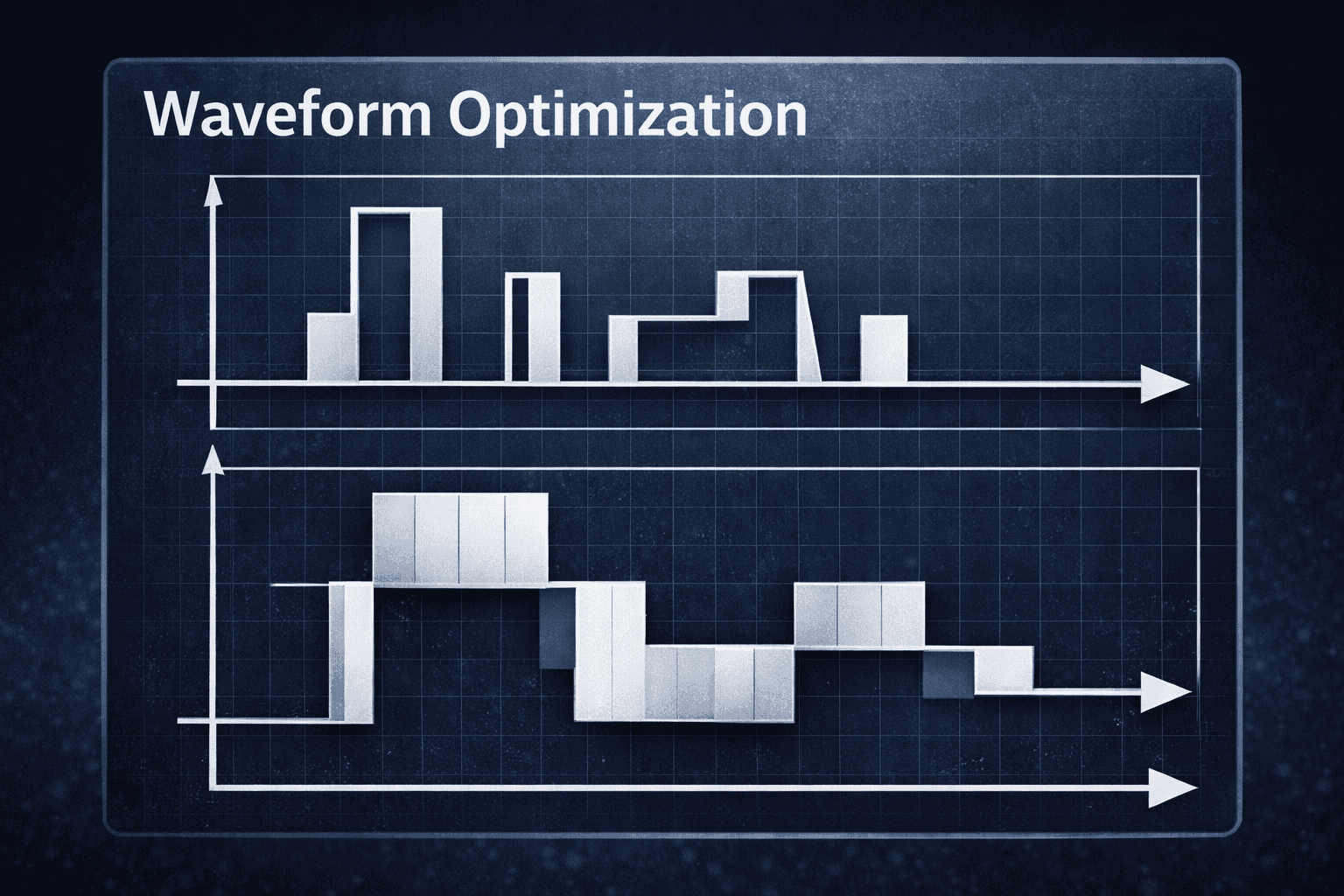
Waveforms are electrical control profiles that regulate the movement of particles within an E-Ink display. The electronic ink responds to these voltage signals to render images or text. This imaging method fundamentally differs from LCD or OLED displays, as E-Paper utilizes a bistable principle – the image remains stable even without power input.
Each display generation, color technology, or application type requires individual waveform profiles – whether for rapid switching times in interactive applications or stable displays at -10 °C in outdoor environments. The significant advantage: correctly tuned waveforms ensure reliable image changes with minimal energy consumption, high image quality, and reduced susceptibility to ghosting.
Waveform Customization
LCD Mikroelektronik possesses extensive experience in the development and optimization of application-specific waveform tables. A profound understanding of E-Ink technology enables the realization of both fast switching times and operation across a wide temperature range – such as at -10 °C.
Such optimizations are particularly in demand for devices with E-Paper displays used under varying environmental conditions or requiring high responsiveness. These include, among others, measurement displays, devices with reading functions, or time displays.
Typical Optimization Areas:
- Temperature-compensated waveform tables down to -15 °C for applications in unheated environments or outdoor areas
- Optimization for fast switching times in interactive or reactive applications
- Reduction of ghosting and image artifacts during frequent partial image updates (Partial Updates)
- Adaptation to various E-Ink technologies
- Optimization for various E-Paper screen sizes and resolutions
This system optimization requires a synergy of embedded development, thermal design, display physics, and firmware adaptation – for instance, through individual Lookup Tables (LUTs) in the display controller.
Waveforms in Practice – Where They Make the Difference
Example: E-Paper Signage at -10 °C
An E-Ink display in an outdoor environment must function reliably even at low temperatures. Without temperature-compensated waveforms, this leads to slowed image rendering, incomplete content, or ghosting. Adaptation to the extended temperature range is crucial for practical applicability.
Example: Measurement Applications
Measuring devices with rapidly changing displays require E-Paper technology with high energy efficiency, fast response times, and stable rendering. Optimized Partial Updates enable smooth and artifact-free transitions – without visible image remnants.
More on fast-switching E-Paper displays: https://lcd-mikroelektronik.de/news/e-paperfastupdate/
Example: Color E-Paper Displays
Color displays based on E-Ink Spectra or Kaleido require complex waveforms to precisely control all color particles. Only through precisely tuned display control can a uniform color image with acceptable response time and good color saturation be achieved.
No Optimal E-Paper Without Suitable Waveforms
The quality of an E-Ink display hinges on proper control. Waveforms form the technical foundation for responsive, power-efficient, and reliable E-Paper applications. To harness the full potential of this display technology, customized solutions are essential – especially for rapid image changes or operation within an extended temperature range.
LCD Mikroelektronik provides the necessary system expertise to optimize E-Paper displays for specific applications – whether for industrial displays, IoT devices, E-Ink readers, digital price tags, or color displays. Investing in tailored waveforms yields significant returns: in image quality, system reliability, and energy efficiency.