Is Blanview Still the Only Option?
In Brief
- Blanview: power-saving, sunlight-readable, but expensive and low-contrast in direct sunlight.
- Optimized IPS/TFTs: nearly identical efficiency, more affordable, better contrast and colors.
- Conclusion: For many applications, modern IPS/TFT displays are the more economical alternative.
⏱ Estimated Reading Time: 3-4 Minutes
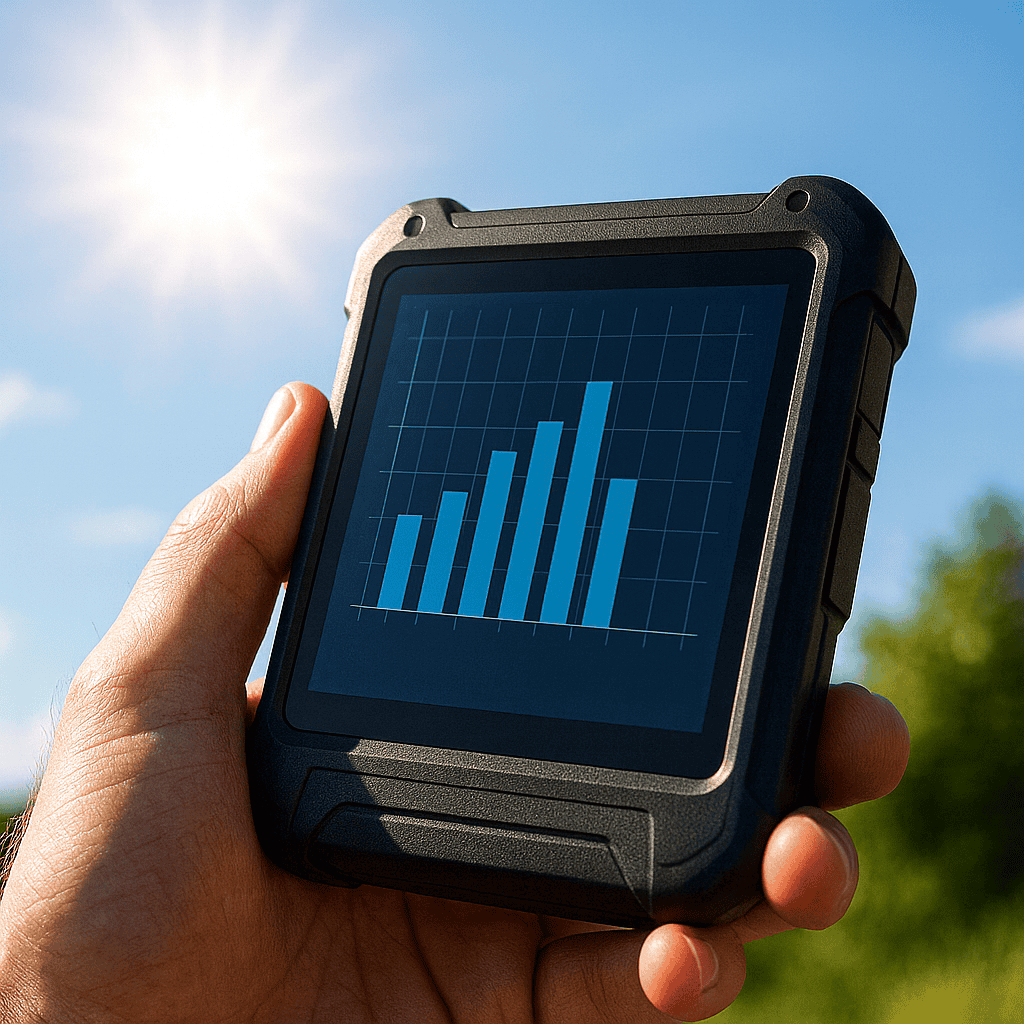
Blanview displays from manufacturers Toppan / Ortustech have been considered a benchmark for power-saving and sunlight-readable TFTs for years. Their transflective structure makes them particularly appealing for mobile, battery-powered devices or outdoor applications. The significant advantage of this technology is that readability is not solely dependent on the backlight: a portion of the ambient light is reflected and utilized for display. This allows for a noticeable reduction in power consumption. In practice, these displays achieve an impressive efficiency of up to approximately 2300 cd/(m²·W). Content remains clearly visible even in bright environments.
Advantages of Blanview Displays
- Good Readability in Direct Sunlight
- Low power consumption (significantly lower than standard TFTs)
- Consistent image display under various lighting conditions
- Durable and suitable for continuous operation
Transmissive TFTs as a competitive alternative
Traditionally, transmissive TFT displays have been considered less suitable for sunlight readability, as they rely entirely on backlighting. However, recent developments indicate that modern transmissive TFT-LCDs – incorporating targeted, industrially established enhancements – can rival or even surpass Blanview technology in specific applications.
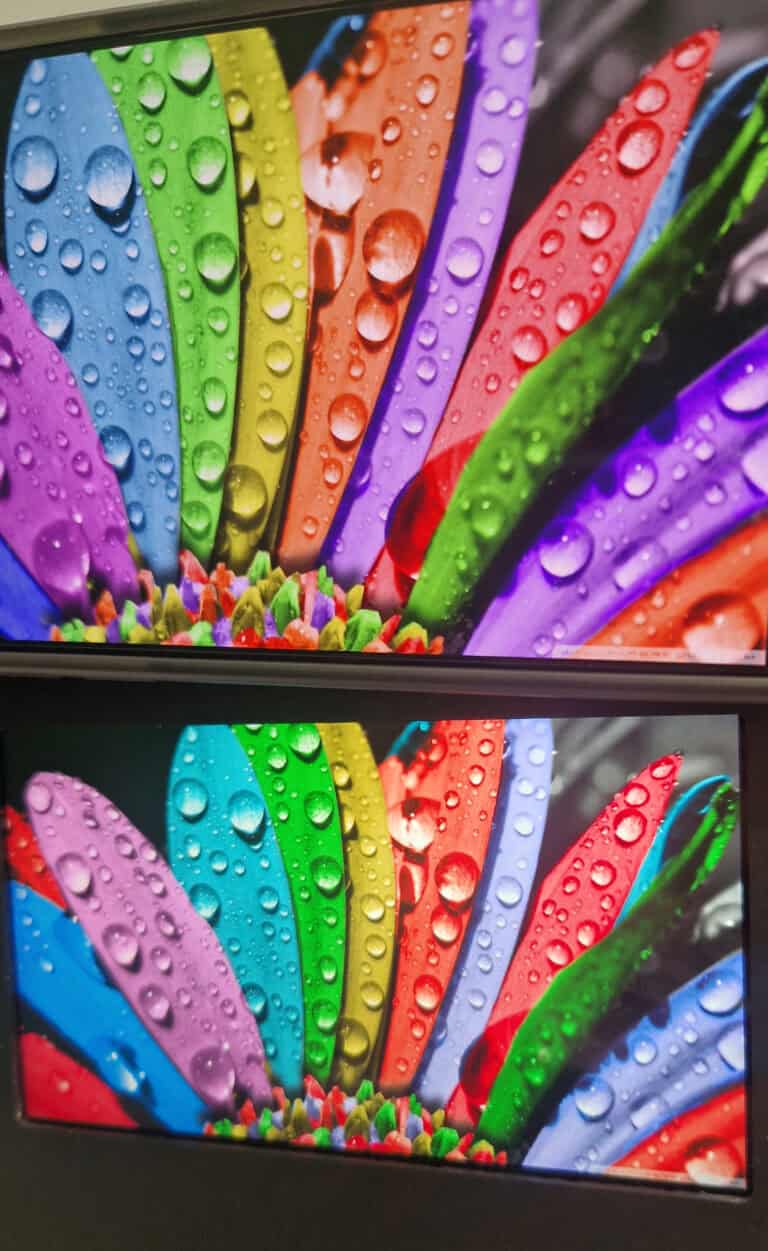
Particularly under direct sunlight, Blanview exhibits a loss of contrast and grayscale differentiation, making images and text appear flatter. Furthermore, the black level is comparatively weak, and the overall presentation appears less vibrant. Another disadvantage is the higher cost: Blanview modules are significantly more expensive than conventional IPS solutions.
Optimized IPS Displays
At this juncture, it is worthwhile to consider modern IPS alternatives. IPS technology is renowned for its excellent viewing angles and overall high image quality. Even standard IPS displays offer stable color reproduction, although their energy efficiency, due to the bright backlight, cannot match Blanview. However, the true breakthrough comes with optimized variants: By utilizing Brightness Enhancement Films (BEF), the backlight's illumination is more effectively directed towards the viewer. This significantly increases efficiency. In combination with a High-Transmission Panel (HTP), further losses can be minimized, allowing these IPS displays to nearly achieve Blanview's performance level.
The crucial difference is that while an IPS display with BEF and HTP achieves slightly lower efficiency values, it simultaneously offers significantly better contrast, deeper black tones, and stable grayscale reproduction – even in direct sunlight. Additionally, there is a price advantage: while Blanview is still considered a premium solution, optimized IPS modules are generally much more cost-effective to procure.
Therefore, for those prioritizing high image quality, robust contrast, and an economical design, optimized IPS displays present an efficient alternative to Blanview displays. For new designs, it should always be evaluated whether a modern IPS solution might be superior.
Optimized transmissive TFTs offer:
- Excellent color reproduction
- Higher luminance levels up to over 1000 cd/m²
- Wide selection of resolutions and form factors
- Lower costs and broader availability
- Good sunlight readability in conjunction with improved coatings
Comparison – Blanview vs. Optimized Transmissive TFT
| Characteristic | Blanview Display | Optimized Transmissive TFT Displays |
|---|---|---|
| Sunlight readability | Good (loss of contrast) | Very good |
| Total power consumption (power consumption of backlight and TFT) | Significantly lower than standard TFT displays | minimal höher (<10%) als Blanview |
| Color reproduction | Good | Very good |
| Cost | High | Cost-effective |
| Availability | Limited (Toppan exclusive) | Very good |
| Contrast Ratio | Moderate | Very good |
Conclusion
Blanview displays offer distinct advantages for energy-sensitive applications with varying light conditions. Nevertheless, it is worthwhile to consider modern transmissive TFT displays: current technology allows many of their former weaknesses to be compensated for, particularly regarding sunlight readability. Depending on the application, budget, and requirements, a high-quality transmissive TFT can represent an equally suitable or even superior solution.
We would be pleased to advise you on Blanview alternatives!
FAQ
What is a Blanview Display?
Blanview is a TFT technology developed by Toppan / Ortustech, featuring a transflective structure. It combines transmissive and reflective properties: a portion of the ambient light is utilized, which reduces the energy consumption of the backlight.
What are the primary advantages of Blanview?
Very high energy efficiency (up to approx. 2300 cd/(m²·W))
Good readability in diffuse sunlight
Energy-efficient and therefore particularly suitable for battery-powered devices
What are the disadvantages of Blanview?
Reduced contrast and grayscale degradation under direct sunlight
Comparatively weak black level
Increased costs, due to exclusive availability from Toppan
Limited selection of sizes and formats
How do IPS displays differ from Blanview?
IPS (In-Plane-Switching) offers:
With optimizations (BEF, High-Transmission-Panel), nearly equivalent efficiency to Blanview, but with superior contrast and black level, excellent viewing angle stability, very good color reproduction, more competitive pricing, and broad availability.
Are IPS displays less readable in sunlight?
Standard IPS is less suitable for sunlight without optimization. However, with Brightness Enhancement Films (BEF) and High-Transmission Panels (HTP), IPS displays achieve high brightness and retain their grayscale levels even under direct sunlight – unlike Toppan displays.
What is a Blanview Display?
Blanview: Premium price, limited availability
Optimized IPS: Significantly more cost-effective, wide selection of manufacturers and modules
For which applications is Blanview suitable?
Mobile devices with maximum energy efficiency
Applications in diffuse sunlight
Niche applications where power consumption is more critical than contrast
For which applications are optimized IPS displays superior?
Industrial HMIs, medical applications, and outdoor devices requiring high image quality
Applications exposed to direct sunlight
Projects prioritizing cost and availability