Development and consolidation of production capacity
Brief summary
- Global production capacity for TFT and OLED displays continues to concentrate, with China set to remain the clear leader through 2030.
- Despite growing OLED capacity, LCD remains the dominant technology, particularly for industrial applications.
- Alternative regions cannot offset the growing concentration, and new production sites are not expected to be relevant in the foreseeable future.
Reading time: 5 minutes
Global Market Conditions and Structural Concentration
Global production of flat-panel displays (FPDs), particularly TFT-LCDs and AMOLEDs, is highly concentrated and will become even more concentrated by the end of this decade. Current market data shows that China is further expanding its dominant role, while global production capacity is growing only moderately. For developers, buyers, and companies, this means a structural dependency that is virtually impossible to avoid.
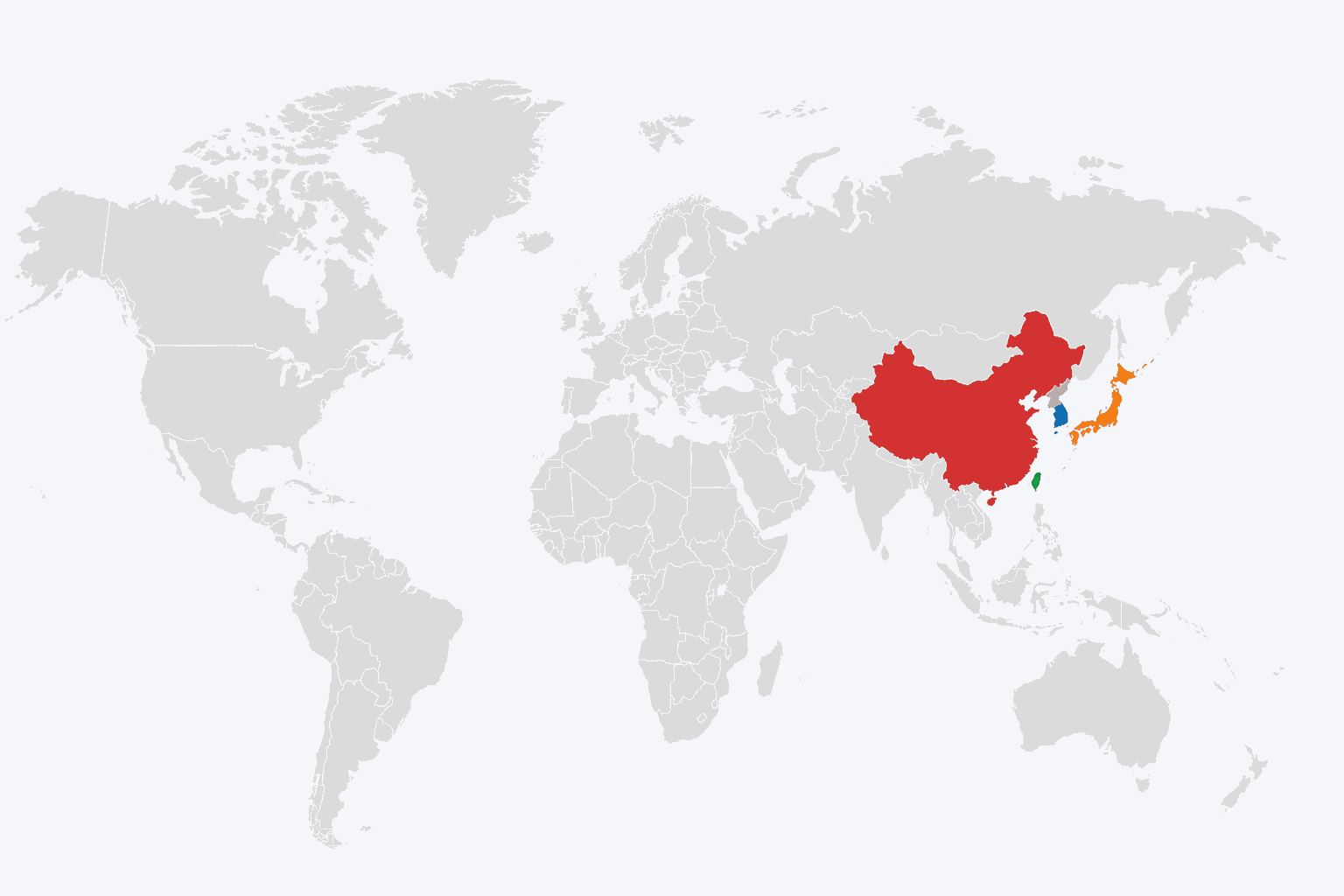
There are currently around 137 relevant display factories worldwide. Of these, approximately 100 use LCD technology and 37 use OLED. This production capacity is concentrated primarily in a few regions, with China leading by a wide margin.
Global Distribution of TFT and Display Factories
Table 1: Regional Distribution of FPD Production Capacity
| Region | Share of FPD capacity in 2025 | Forecast for 2030 | Development |
|---|---|---|---|
| China | approx. 73% | about 75% | growing |
| South Korea | approx. 8% | approx. 8% | stable |
| Taiwan | approx. 17% | about 15% | declining |
| Japan | approx. 2% | about 1% | sharply declining |
| India | 0 % | 0 % | no implementation |
China continues to expand its production capacity, particularly in the area of large TFT-LCD displays and advanced OLED technologies. Leading manufacturers such as BOE, CSOT, and HKC dominate the market and together account for nearly 60 percent of global production capacity.
Technology Breakdown: LCD Remains Dominant
At the same time, LCD remains the dominant technology, even though OLED is growing faster. OLED’s share of total capacity is rising only moderately and remains well behind that of LCD.
Table 2: Technology Breakdown in Display Production
| Technology | Share in 2024 | Forecast for 2030 | Development |
|---|---|---|---|
| LCD (TFT) | approx. 91% | approx. 89% | slightly down |
| OLED | approx. 9% | approx. 11% | growing |
Lack of geographic diversification
A particularly relevant issue for the industry is the lack of geographic diversification.
India has been discussed in the past as a potential new location for display factories. Initial production was originally expected to begin in 2029. However, these plans have not materialized. Currently, there is no significant TFT or OLED production in India, and no relevant capacity is foreseeable in the medium term.
This means that China remains by far the most important production location.
The role of individual regions in detail
South Korea continues to play a key role in technology, particularly in the OLED sector. Companies such as Samsung Display and LG Display are driving innovation. However, this capacity is only available to the open market to a limited extent. Much of the production is geared toward meeting the groups’ internal needs, such as for smartphones or televisions. As a result, these sources are often not accessible for industrial applications or smaller quantities.
Taiwan is often viewed as an alternative to China. Manufacturers such as AUO and Innolux serve international customers and offer robust technical solutions. Nevertheless, Taiwan is not a complete solution for companies seeking to specifically reduce their dependencies. In the long term, production capacity is declining, many suppliers are focusing on existing customers, and large parts of the supply chain remain closely tied to China. Geopolitical risks are also increasingly factored into assessments.
Today, Japan is merely a niche player in TFT and AMOLED production. Its share of global production capacity stands at around one percent. Japanese manufacturers focus on specialized applications with high quality requirements and domestic customers. When it comes to standard TFTs or high-volume production, Japan is of little economic significance.
Classification of Procurement Options
Table 3: Comparison of Regions from a Procurement Perspective
| Region | Availability | Scalability | price level | Suitability for industrial use |
|---|---|---|---|---|
| China | high | very high | low | very good |
| Taiwan | medium | limited | medium | good |
| South Korea | low | low | high | restricted |
| Japan | low | low | high | specialized |
| India | not available | not available | – | not an option |
Implications for Businesses and Developers
In summary, the picture is clear. The production of TFT and AMOLED displays is highly concentrated on a global scale, and there are currently no fully independent alternatives to the established Asian supply chains. China, in particular, remains the central hub of manufacturing.
For companies, this means that complete independence is not currently realistic. Instead, the focus is on risk management, strategic procurement, and technical flexibility. This includes, among other things, the use of standardized display modules, alternative interfaces such as SPI, LVDS, or eDP, as well as proactive lifecycle and obsolescence planning.
The globalization of the display industry is not a temporary trend, but a structural reality that must be taken into account when selecting and integrating TFT and OLED displays.
Further information:
https://www.counterpointresearch.com/display/

Our editorial team is responsible for the content and technical accuracy of this article. Artificial intelligence was used solely as a supporting tool.