A display innovation for medical technology, the automotive industry, and high-end displays
Brief summary
- QROD offers AMOLED-like colors: ~96% DCI-P3 with clear, consistent color reproduction.
- Industrial-grade & durable: No burn-in, no organic aging, high temperature stability.
- Flexible & scalable: Suitable for everything from small automotive displays to large-format professional panels.
Reading time: 5–6 minutes
Quantum Rod LEDs combine AMOLED-like color brilliance with industrial-grade TFT durability
Professional displays are evolving rapidly. Today, applications in medical technology, the automotive industry, industrial automation, and digital signage require:
- highest color accuracy
- long-term availability
- high brightness
- industrial-grade durability
QROD (Quantum Rod LEDs) technology is designed to meet precisely these requirements. It combines the mechanical stability of traditional TFT-LCDs with a level of color brilliance that was previously reserved primarily for AMOLED displays.
A key advantage:
QROD is fully scalable regardless of size—from small automotive clusters to large-format signage displays.
Vibrant colors through directional emission
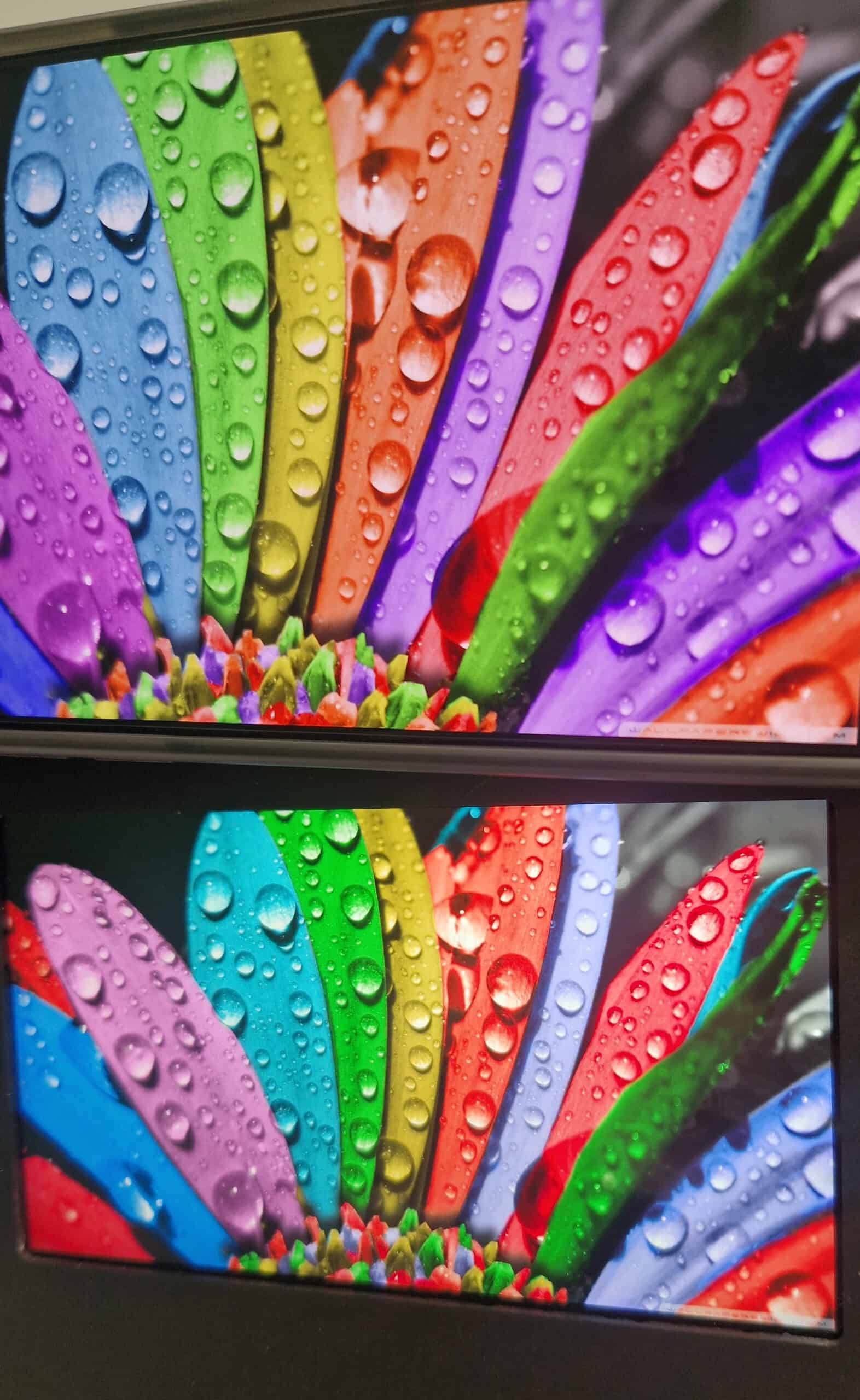
QROD typically covers approximately 96% of the DCI-P3 color gamut, which is becoming increasingly important in professional applications such as medical displays, broadcast monitors, and high-brightness displays.
Due to the narrow spectral emission, colors appear more saturated, more sharply defined, and easier to distinguish than on conventional TFT-LCDs.
Quantum Rod LEDs thus deliver color reproduction similar to AMOLED, but without the risk of burn-in, without organic degradation, and without limitations on display size.
Cost savings resulting from the elimination of the QD film
Since QROD does not require a large-area quantum dot film, several process steps that are critical to cost and yield are eliminated.
Filmless architecture:
- reduces material costs
- reduces production errors
- increases thermal stability
- improves the long-term uniformity of the backlight
This is a significant advantage for industrial displays, outdoor signage, and 24/7 applications.
The Importance of QROD for Various Applications
Professional displays used in medical technology, the automotive sector, industrial automation, digital signage, and control rooms face similar fundamental requirements despite their diverse application scenarios. These include high color accuracy, long-term stability, industrial ruggedness, and reliable performance over many years. QROD addresses these requirements across all technologies.
Thanks to their near-LED color conversion, Quantum Rod LEDs achieve high color gamut coverage while maintaining stable spectral emission throughout their entire lifespan. This is particularly relevant for medical displays used for diagnostic purposes, for automotive HMIs with safety-critical color information, and for industrial and professional monitors in continuous operation. Colors remain reproducible and exhibit minimal drift, even at high brightness levels and elevated ambient temperatures.
Since QROD does not use any organic materials, neither burn-in effects nor age-related degradation occur. This is a key advantage for applications featuring static UI elements, such as instrument clusters, control panels, control stations, or information and signage displays operating 24/7.
Another key feature is full scalability across all display sizes. QROD can be used in small automotive displays, medical monitors of various sizes, and large-format industrial and signage displays. This allows manufacturers to achieve consistent color reproduction across their product portfolio without having to switch to different display technologies based on size.
Quantum Rod LEDs also offer advantages from a systems perspective. The technology is compatible with existing TFT architectures and can be integrated into existing designs, regardless of touch technologies or mechanical requirements. At the same time, it enables high luminance levels with good efficiency, which is relevant for both automotive interiors and bright industrial or outdoor environments.
Overall, QROD positions itself as a universal backlight technology for professional displays in the medical, automotive, industrial, and signage sectors—anywhere where visual quality must be combined with industrial reliability and long-term availability.
Technical Comparison
| criterion | Standard TFT-LCD | QDEF-LCD | QROD-LCD |
|---|---|---|---|
| Color space (DCI-P3) | about 85% | 90–95% | approx. 96% |
| Color stability | medium | good | high |
| Efficiency | medium | good | very good |
| Size availability | very high | medium | completely |
| Risk of burn-in | none | none | none |
| Production costs | low | high | medium, falling |
| Suitability for outdoor use | good | good | very good |
FAQ
Not in a technical sense. However, in many professional applications, QROD offers a genuine alternative. The technology achieves color brilliance comparable to AMOLED, yet offers a full range of sizes, long-term industrial availability, and is free from organic aging and burn-in.
Traditional QLED displays use a quantum dot film in the backlight. QROD integrates the color conversion directly onto the LED chip. This reduces optical losses, lowers thermal stress, and increases efficiency.
Quantum rods are mechanically and thermally stable when embedded in the LED chip. Typical QROD backlights remain spectrally stable within the temperature range of –40°C to +85°C.
QROD backlights typically last between 50,000 and 70,000 operating hours and maintain better color stability than film-based quantum dot systems.
The integration effort is minimal. Existing TFT designs can continue to be used; only the LED backlight needs to be modified.