With Spectra 6, E Ink has introduced a new generation of full-color E-Paper displays specifically developed for use in advertising, PoS systems, digital signage solutions, and information displays.
Unlike traditional LCD or OLED panels, E-Ink displays operate reflectively. This means they do not require backlighting – a significant advantage for visual comfort and power savings. Spectra 6 elevates this principle to a new level through vibrant colors, high image quality, and minimal power consumption.

Technological Characteristics of Spectra 6 E-Ink Technology
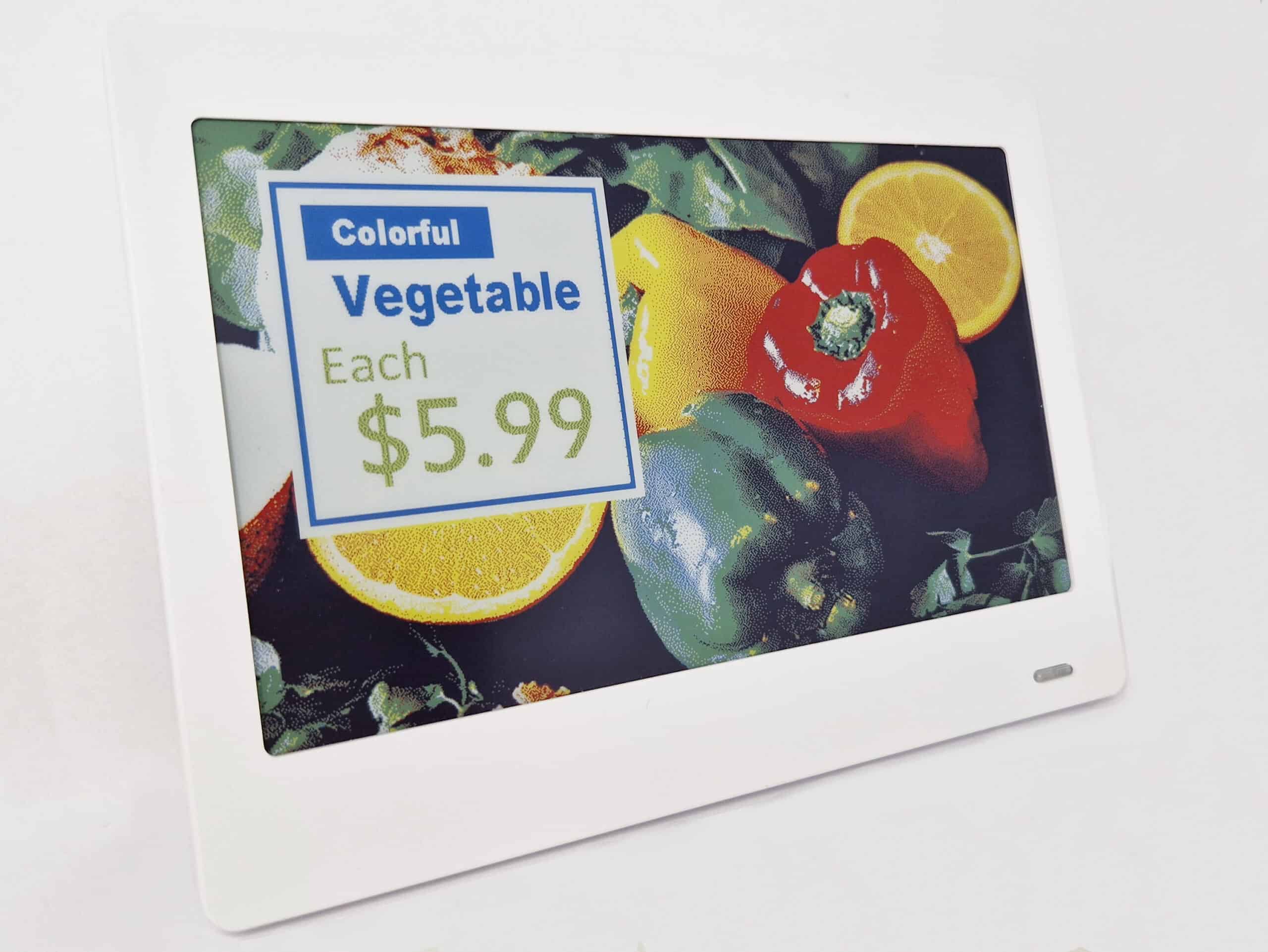
Spectra 6 utilizes four different color pigments (white, blue, red, yellow) that can represent six colors: black, white, cyan (blue), magenta (red), yellow, and green. In combination, up to 60,000 colors can be generated – an immense advancement compared to previous three-color ePaper technologies. The image resolution is up to 200 ppi – corresponding, for example, to 1600×1200 pixels on a 13.3″ display. The system also excels in contrast ratio: with up to 30:1, colors appear particularly clear and legible against the white background – ideal for transflective displays in bright environments.
A key advantage of E-Paper technology is that the image remains visible even without power supply. Power consumption is limited to the moment of image refresh – typical for a bistable display. This makes Spectra 6 an optimal solution for battery-powered applications such as digital price tags, autonomous information boards, or electronic posters.
Display Sizes & Integration
Available Spectra 6 E-Ink panel sizes range from compact 4″ modules to impressive 75″ screens. Popular sizes such as 7.3″, 8.1″, or 13.3″ are ideal for smart room signage, retail displays, and E-Ink applications in retail. Large panels of 25″, 31″, or 75″ are excellently suited for E-Ink advertising, art applications, or public displays, as they are both functionally and aesthetically compelling.
System integration is flexible: smaller displays often utilize SPI or QSPI, while larger ones employ LVDS. E Ink provides suitable developer kits, libraries, and so-called waveform files to optimally control color reproduction and image refresh.
Refresh & Application Areas
When planning a project with Spectra 6, it should be noted that a full image refresh can take several seconds. Therefore, the technology is best suited for content that is updated infrequently – such as price tags, event displays, calendars, or artworks. The operating temperature typically ranges between 0 °C and 50 °C, which primarily favors its use indoors or in protected areas.
However, the possibility of selective partial refreshing is noteworthy, as it allows for simple animations without reloading the entire display. Nevertheless, a full image refresh takes – depending on temperature and panel size – between 10 and 30 seconds. Therefore, the technology is ideal for static content such as calendars, event information, digital artworks, or electronic signs.
Overall, E-Ink Spectra 6 represents a groundbreaking development for those seeking colorful, power-efficient, and visually high-quality displays that operate without a permanent power supply. The combination of sustainability, brilliant color representation, and flexible sizing makes this technology particularly attractive for applications where conventional displays would be too energy-intensive or inflexible.
How Microcups Work
Spectra 6 technology is based on Microcup technology, where microscopic containers (Microcups) filled with electronic ink are situated on a substrate material. Each segment contains a fluid with electrically charged color pigments. The display operates purely electrophoretically – entirely without liquid crystals or light filters, which are common in TFT displays. The result is an extremely reflective display that remains perfectly legible even in direct sunlight.
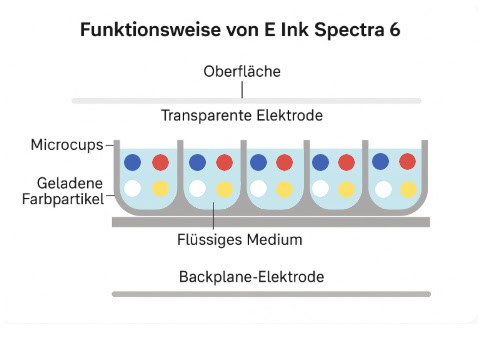
The pigments are electrically charged and can be moved up or down within the cell by means of a targeted electric field. The visible color impression is created depending on which pigment appears on the surface. The remaining pigments are in the background and are not visible.
Image formation occurs purely through electrophoretic movement, meaning without liquid crystals or light filters, unlike TFTs. Control is pixel-accurate, with each pixel selectively driven by a combination of voltage pulses. This allows for the display of millions of color combinations – even though only one visible color is active per pixel.
Learn more directly from E-Ink:
https://www.eink.com/brand/detail/Spectra6