Opportunity for special format requests or risk due to patents and production process?
In Brief
- Customized formats: Cut TFT displays are created by subsequently shortening standard displays.
- High technical requirements: The cutting process is complex and causes high scrap rates.
- Legal uncertainties: Patents in the EU and the US may restrict customization, especially if manufacturing is not licensed.
- Alternative recommended: Standardized Bartype TFTs are now available in many formats.
⏱ Estimated reading time: 3 minutes
In the world of display technologies, screens are increasingly being tailored to specific applications. As a result, so-called “cut TFT displays” are frequently used, particularly in space-constrained designs or in the HMI sector for industrial control systems. By cutting standard TFT cells, unusual formats can be achieved without expensive tooling. But how does this actually work? And what risks does this approach entail?
What does “cut TFT displays” mean?
Cut displays are modules in which a standard TFT LCD panel is subsequently cut to a customer-specific size. This is usually done with TFT LCDs that were originally manufactured for a larger standard resolution.
As a rule, the panel is only cut on one side, opposite the contact strip (FPC/COF). This leaves the control and control electronics intact. However, this also means that the output size of the panel must be chosen carefully so that the resulting format meets the requirements for size (in inches) and resolution.
After cutting, the open edge is sealed with a special adhesive to prevent the liquid crystal from leaking out. This process is technically demanding because the glass substrate is sensitive and the sealing step must be performed perfectly to ensure long-term tightness and stability.
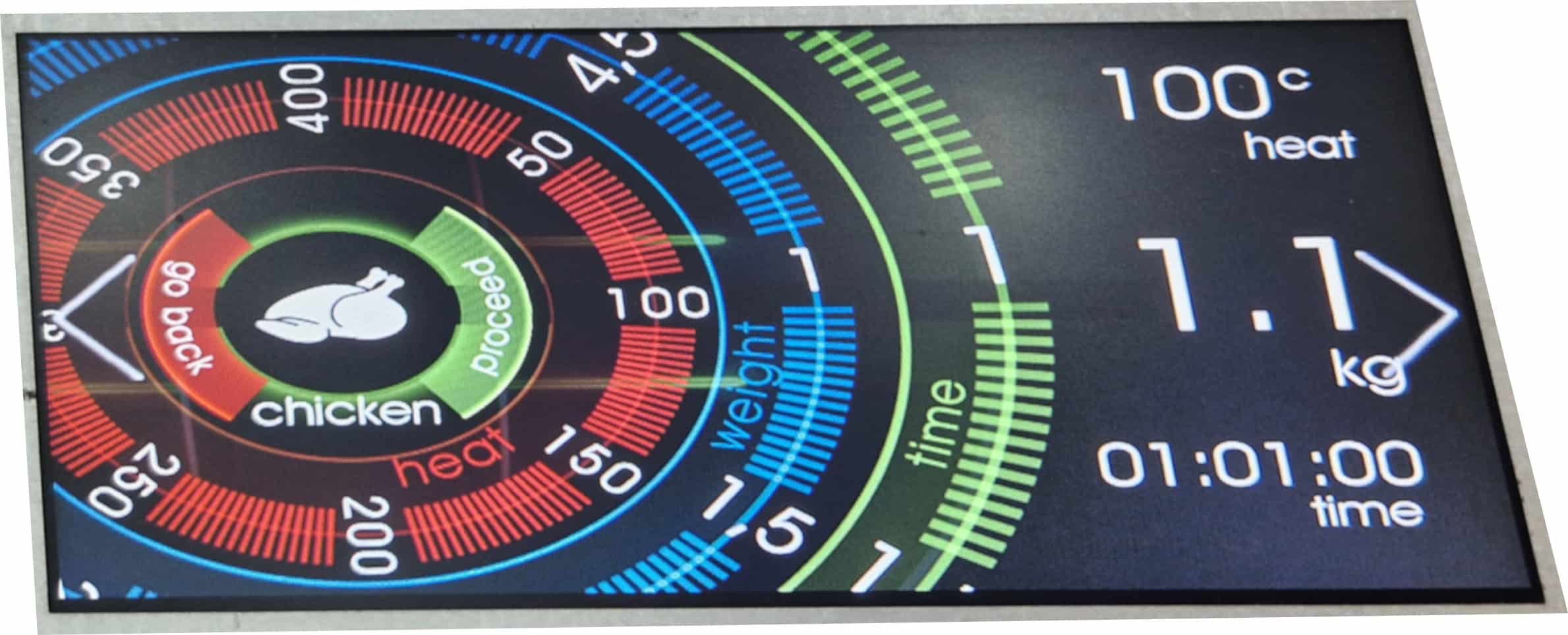
How is a TFT cut?
TFT displays are usually cut using highly specialized laser processes. The following aspects must be taken into account:
- Precision: The substrate (usually glass) must be separated with micrometer precision without destroying the pixel structure or conductor tracks.
- Protective layers: Polarizing films, touch panel layers, and any light filters must then be adjusted or replaced.
- Electronics: The control system (driver ICs) must not be impaired.
- Backlighting: In many cases, the backlighting must be readjusted or partially reconstructed, which poses additional challenges in terms of display brightness and uniformity.
The rejection rate is high, as even minimal cracks in the glass or impurities render the entire module unusable. Handling the sensitive glass substrates requires a great deal of experience and special equipment.
Problems and risks associated with the use of cut TFTs
- Reliability:
- Cut TFT displays may be more susceptible to failure due to microscopic damage.
- Long-term stability and response time are often not documented or tested.
- Costs:
- The committee and the effort required for follow-up work lead to significantly higher unit prices.
- There are often one-time costs for cutting and qualification.
- Patent protection:
- Various patents exist in the EU and the USA in the field of TFT manufacturing and post-processing.
- Subsequent cutting of displays may violate property rights, especially if this is done outside of licensed production processes.
- The American patent in particular is very strict, so caution is advised when exporting to the USA.
- EMC and electrical properties:
- Removing edge structures may impair electromagnetic compatibility (EMC).
- Capacitive touch is often sensitive to mechanical modifications.
Alternative: Standardized Bartype TFTs
Instead of cut displays, so-called bar-type TFTs are increasingly recommended. These are already designed ex-works for a long, narrow format, e.g., 12.3", 7.84", or 4.6" with resolutions such as 1280×200 or 480×128 pixels.

Advantages and overview
- Industrially tested and reliable
- Long-term availability thanks to established manufacturers and defined supply chains
- No risk regarding patents or reworking
- Less effort required for integration and certification
- Optimized modules with coordinated backlighting and touch panel options
| criterion | Cut TFT displays | Bar-type TFTs |
|---|---|---|
| format flexibility | Very high – free length cuts possible | Medium – depending on available formats |
| Customization | Possible, but technically complex | Limited, but many variants now available |
| Technical effort | Very high – laser cutting, sealing, adjustment of backlight and touch if necessary | Low – ready-made modules, ready for integration |
| Reliability / Quality | Limited – risk of microdamage, less documented | High – industrially tested, documented specifications |
| production committee | Highly sensitive cutting process | Low – standardized manufacturing |
| Cost | High – one-time costs + high unit prices due to rejects | Economical – stable prices through series production |
| Legal risks (patents) | High – especially in the US and EU | None – Use of licensed designs |
| Long-Term Availability | Uncertain – depending on initial panel | Uncertain – Medium – Depends on the panel and application |
| EMC & electrical properties | Affected by edge loss | Optimized – EMC-compliant designs |
| Typical Applications | Special solutions with extreme space requirements | Industrial displays, control systems, infotainment |
Conclusion: Special solution for special cases
Cut TFT displays can be a solution in special cases, but they carry considerable risks in terms of reliability, cost structure, brightness, and legal certainty. Careful consideration is necessary, especially in professional applications.
If you want to be on the safe side, you should opt for standardized Bartype TFTs, which are now available in many sizes, resolutions, and variants and represent a robust, economical solution for a wide range of applications.
Check out the Bartype TFTs available as standard
| Diagonal | Type | Part No. | Active Area | Resolution | External Dimensions | Brightness | Interface | Touch | Operating Temp | Technology |
|---|---|---|---|---|---|---|---|---|---|---|
| 0.96 | Bar Type TFT | LCD096LAB-02-100N | 10.8×21.696 | 80×160 | 13.8 × 28.0 × 1.9 | 400 | SPI | IPS,ALL | ||
| 1.08 | Bar Type TFT | LCD108LAA-01-100N | 22.7×42.72 | 128×220 | 17.12 × 29.76 × 1.6 | 350 | serial | IPS,ALL | ||
| 1.9 | Bar Type TFT | LCD190LAB-01-100N | 22.7×42.72 | 170×320 | 25.8 × 49.72 × 1.43 | 350 | serial | IPS,ALL | ||
| 1.99 | Bar Type TFT | LCD199LAA-01-100N | 22.7×42.72 | 170×320 | 25.8 × 49.72 × 1.43 | 600 | serial | IPS,ALL | ||
| 2.18 | Bar Type TFT | LCD218LAB-01-100N | 21.72×52.416 | 200×480 | 25.72 × 59.49 × 2.3 | 250 | MIPI | IPS,ALL | ||
| 2.18 | Bar Type TFT | LCD218LAB-01-100N | 21.72×52.416 | 200×480 | 25.72 × 59.49 × 2.3 | 250 | MIPI | -20 +70 | IPS, ALL | |
| 2.41 | Bar Type TFT | LCD241LAA-01-100N | 30.192×53.28 | 272×480 | 33.89 × 60.32 × 2.18 | 500 | MIPI | IPS,ALL | ||
| 2.86 | Bar Type TFT | LCD286LAA-02-100N | 26,508×67.68 | 376×960 | 31.2 × 76.6 × 2.1 | 200 | SPI/RGB | IPS,ALL | ||
| 3.9 | Bar Type TFT | LCD390LAB-01-100N | 95.04×25.35 | 480×128 | 105.24 × 37.8 × 3.6 | 420 | RGB | IPS,ALL | ||
| 3.99 | Bar Type TFT | LCD399LAA-01-100N | 39.18×94.032 | 400×960 | 44.4×103.88×2.2 | 280 | RGB | IPS,ALL | ||
| 3.99 | Bar Type TFT | LCD399LAA-01-100N | 39.18×94.032 | 400×960 | 44.4×103.88×2.2 | 280 | SPI/RGB | -20 +70 | IPS, ALL | |
| 4.58 | Bar Type TFT | LCD458LAA-01-100N | 26.77×110.3 | 320×960 | 41.57 × 118.8 × 2.5 | 300 | RGB | IPS,ALL | ||
| 5.19 | Bar Type TFT | LCD519LAA-01-100N | 40.75×125.38 | 416×1280 | 45.15 × 132.58 × 3.54 | 400 | MIPI | IPS,ALL | ||
| 6.1 | Bar Type TFT | LCD610LAA-01-100N | 29.99×152.51 | 280×1424 | 33.99 × 160.31 × 2.8 | 220 | MIPI | IPS,ALL | ||
| 6.86 | Bar Type TFT | LCD620LAA-01-100N | 148.8×53.76 | 640×240 | 164.1 × 72.06 × 3.65 | 430 | RGB | IPS,ALL | ||
| 6.86 | Bar Type TFT | LCD686LAB-01-100N,C | 60.19×160.51 | 480×1280 | 67.0 × 181.4 × 5.0 | 600 | MIPI | Capacitive | IPS,ALL | |
| 6.9 | Bar Type TFT | LCD690LAA-01-100N | 33.6×170.88 | 280×1424 | 38.2 × 181.47 × 3.54 | 400 | MIPI | IPS,ALL |