What is an SPI-TFT Display?
TFT displays with an SPI (Serial Peripheral Interface) are a particularly space-saving and cost-effective solution for microcontroller projects where data transfer speed and straightforward wiring are crucial. Unlike parallel interfaces, SPI displays require only a few pins, making them ideal for embedded systems, IoT devices, control units, or DIY electronics projects. TFT displays with SPI are particularly popular due to their excellent performance.
Which TFT Displays are Available with SPI?
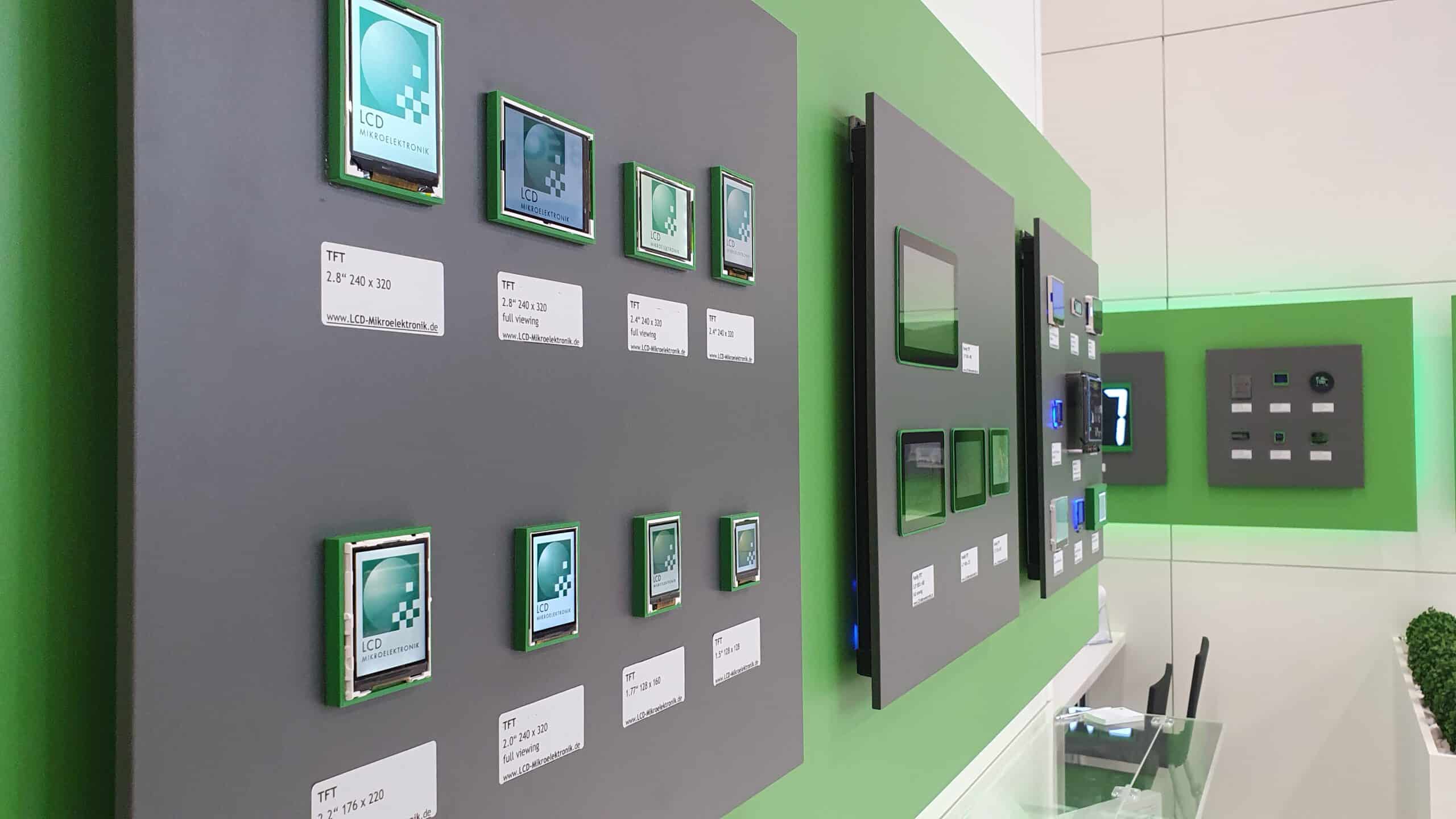
A wide variety of compact SPI-TFT modules are available, primarily in sizes ranging from 1.44 inches to approximately 3.5 inches. These SPI-TFT displays are highly versatile and are utilized in numerous applications.
The most common SPI-TFTs offer resolutions up to 480×320 pixels, especially in 3.5-inch modules. Higher resolutions (e.g., 800×480 or Full-HD) are not technically feasible via SPI due to bandwidth limitations. Therefore, parallel interfaces such as RGB, LVDS, or MIPI-DSI are typically used for high-resolution displays.
Transitioning from Passive LCD to SPI-TFT – Easier Than Expected
Many older devices utilize monochrome passive LCDs with parallel interfaces. Those intending to upgrade to a color display often face the question: Which interface is appropriate?
Why SPI is the Easier Transition:
- SPI requires only a few pins – ideal for limited microcontroller resources
- Simpler software integration through readily available libraries
- No complex timing or pixel clock signal required, unlike with RGB displays.
- Reduced EMC issues compared to parallel high-speed interfaces.
- SPI-TFT modules are often available as plug-and-play units – ideal for rapid prototyping or testing.
Conclusion: An SPI-TFT often serves as a faster, simpler replacement for an older LCD, without requiring extensive hardware modifications.
What considerations are necessary?
When implementing SPI-TFTs, several important aspects should be considered during selection and integration:
1. SPI Clock Frequency
Not all displays can tolerate high clock rates. Some modules are limited to 4–8 MHz, while others support up to 40 MHz. Compatibility with the microcontroller should be verified.
2. Display Controller
Controllers such as ILI9341, ST7735, or HX8357 differ in initialization, color depth, and commands. Selecting the correct library is crucial.
3. Touchscreen Support
Many SPI displays feature a separate touch controller (e.g., XPT2046), which is also controlled via SPI or I²C. In this context, pin assignment is particularly critical.
4. Voltage Levels
Some modules require 3.3 V logic levels, while others are 5 V tolerant. Newer drivers now tend towards lower voltages of 1.8 V with a 3.3 V maximum.
Level shifting or suitable converters may be necessary.
5. Refresh Rate
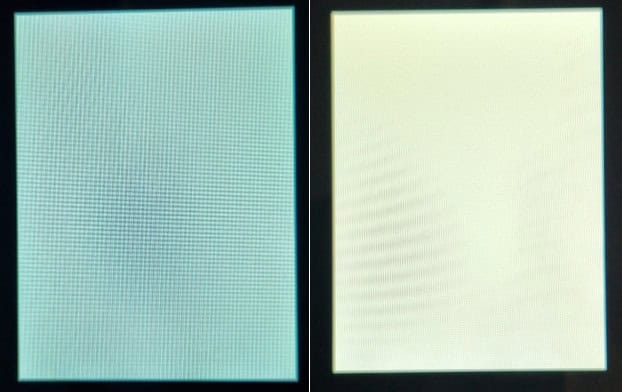
For higher-resolution TFTs, the refresh rate is low (e.g., with a 10 MHz clock frequency, a 16-bit color depth TFT, and 320×240 pixels, resulting in 10,000,000 / (320*240*16) = 8.1 frames per second). In such cases, tearing* must be considered (suppression can be achieved, for instance, by utilizing the TE signal).
Animations are also not optimally achievable. Eight frames per second are insufficient for smooth animation; we recommend at least 15. To achieve this, the frame rate must be increased, which may necessitate raising the clock rate (see point 1). A potential solution for this is the implementation of QSPI (requiring a QSPI-capable driver or microcontroller).
* Tearing in SPI-TFT displays occurs when the display's frame buffer is updated during image rendering (e.g., during refresh or scrolling). This results in a portion of the old image and a portion of the new image being displayed simultaneously.
5. Cable Length
SPI is not designed for long distances. Signal interference can occur at approximately 30–50 cm, which is why shielded cables or twisted pair wiring are recommended.
Conclusion: When is an SPI-TFT beneficial?
SPI-based TFT displays are ideal for small-format display applications where:
- Space and pin count are limited
- High refresh rates are not required
- cost-effective, robust solutions are required
- a transition from a passive LCD to a cost-effective TFT alternative is intended
They offer a straightforward entry into TFT technology. For those migrating from passive LCDs, SPI-TFTs present a particularly uncomplicated solution.
Interested in SPI-TFT modules?
At LCD Mikroelektronik, we offer a wide range of SPI-compatible TFT displays in various sizes and resolutions – including technical consultation and customization for your project.
Contact us or request a sample directly!