
How Chinese Holidays Affect Delivery Times
Brief summary
- Golden Week: In early October, there will be production disruptions and possible delays in China.
- Chinese New Year: Due to longer delivery times, the New Year celebration must be planned months in advance.
- Supply Chain: Not only manufacturers, but also suppliers and logistics providers need time to get back up and running after the holidays.
- Early Planning: Coordinate quantities and delivery dates in a timely manner to avoid critical periods as much as possible.
Reading time: 5 minutes
Golden Week in early October is just around the corner. For companies that source products and electronic components from China, this means they should double-check their production and delivery schedules now.
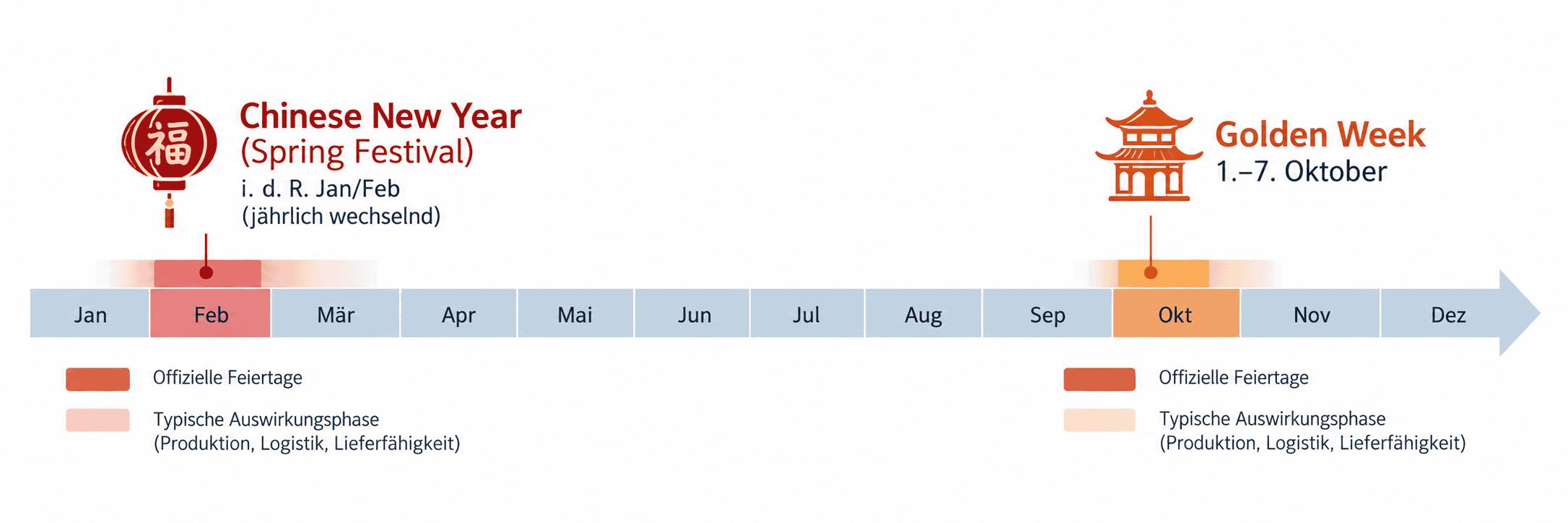
At the same time, attention is already turning to the next Chinese New Year. Even though the Chinese New Year doesn't begin until February, it must be taken into account now for products with longer sourcing and production lead times.
For example, anyone who needs displays, electronic components, or custom assemblies for the first quarter should coordinate their requirements as early as possible. This is because it’s not just the official holidays that matter. Production capacity and transportation options can become scarce as early as the weeks leading up to the holidays. After the holidays, the supply chain needs time to get back up and running at full capacity.
Right now, two important planning periods are overlapping: In the short term, Golden Week is just around the corner, while at the same time, planning for the Chinese New Year is already underway for many projects.
Golden Week: Production will be partially halted in early October
Around the time of the Chinese National Day in early October, many companies shut down for several days. The impact is generally less pronounced than during the Chinese New Year, but there are still effects related to orders being brought forward and made up for later.
Manufacturers are trying to complete production and deliveries before the holidays begin. At the same time, demand for production and transportation capacity is rising. After Golden Week, outstanding orders and shipments must be processed accordingly. The Western Christmas season, as a peak time for transportation, also drives up prices and affects availability.
For projects with tight deadlines, it is therefore important to check whether confirmed production and shipping dates might be affected by the holidays.
Chinese New Year: Planning Begins Well Before the Holiday
While Golden Week is just around the corner, the upcoming Chinese New Year must already be taken into account when it comes to longer delivery times.
The Chinese New Year, also known as the Spring Festival, is the most important holiday in China. Many employees use this time to travel to their home regions to visit their families. Especially in China’s major manufacturing centers, many people work far from their hometowns.
As a result, the impact on production often begins even before the actual holiday.
Even if a company is officially closed only for a limited period of time, that does not automatically mean that production is running at full capacity immediately before and after that period.
In practice, manufacturing facilities may have limited production or no production at all for two to three weeks around Chinese New Year. The actual duration of the interruption depends heavily on the specific company, its workforce, and its supply chain.
Full capacity will not be available immediately after Chinese New Year
Another factor is often underestimated in European procurement planning: Not all employees return to their previous employer after the Chinese New Year.
The period around New Year’s is traditionally also a time when employees change jobs. For manufacturing companies, this can mean that they initially face a shortage of staff after the holidays.
Production lines are being gradually restarted, and new employees may need to be hired and trained. As a result, it may take some time before production capacity returns to normal levels.
This effect must be taken into particular consideration for customer-specific products. Trained employees, defined inspection procedures, and a robust quality assurance system are essential prerequisites for reproducible manufacturing.
The entire supply chain is crucial
Even if the actual manufacturer has resumed production, the relevant suppliers must also be able to deliver.
For example, a display involves numerous components and manufacturing steps. These can include, among other things, display cells, driver ICs, FPCs, backlights, touch sensors, printed circuit boards, plastic and metal parts, and packaging materials.
The supply chains for many other electronic products and components are similarly complex.
Added to this are assembly and testing processes, as well as logistics. Freight forwarders, truck transportation, customs, ports, and air cargo capacity must also return to normal operations.
If even one component in this chain becomes available later than expected, the completion date for the entire product may be delayed.
After Chinese New Year, therefore, it is not just a single factory that needs to resume operations, but an entire network of manufacturers, suppliers, and logistics service providers.
Things can get tight even before Chinese New Year
It's not just the period after the holidays that's critical. The pressure to meet deadlines also increases in the weeks leading up to them.
Many companies try to complete and ship current orders before the holidays begin. This, in turn, increases the demand for production and transportation capacity.
Bottlenecks can occur, especially with time-sensitive shipments. Available production capacity at manufacturers and suppliers is also becoming increasingly scarce as Chinese New Year approaches.
Placing an order at the last minute before the holidays therefore does not automatically guarantee that the goods will leave China in time. Often, the goods simply get stuck at customs and are no longer processed.
Our recommendation: Plan for your needs early on
Based on our experience, it makes sense to coordinate your needs for the first quarter with us well in advance.
If materials are needed in February or early March, we will try, whenever possible, to schedule production and shipping so that the goods are dispatched before Chinese New Year.
Depending on your needs, it may make more sense to bring forward a delivery and then intentionally plan with a larger time buffer than to rely on production immediately after Chinese New Year.
Delivery dates in late February or early March, in particular, can be challenging. At that time, some manufacturers may already be back to normal operations, while other parts of the supply chain may not yet have fully regained their normal capacity.
The best approach to planning always depends on the specific product and the respective supply chain. Depending on the design, the required components, and the production process, material and production lead times can vary significantly. Early coordination is therefore particularly important for custom displays and electronic assemblies.
Early planning reduces scheduling risks
Chinese holidays are a normal part of international supply chains. They become particularly problematic when their impact is not taken into account until shortly before the desired delivery date.
Our recommendation is therefore: Plan your needs well in advance and coordinate quantities and desired delivery dates with us in a timely manner. This will allow us to factor in the necessary material, production, and shipping times accordingly.
Are you planning a project or do you need merchandise for Chinese New Year or Golden Week? Please contact us well in advance. Together, we’ll determine which production and delivery dates are realistic given the specific circumstances.
FAQ
For custom products with longer material and production lead times, the Chinese New Year should be factored in several months in advance. It is not only the holiday itself that is crucial, but also the high volume of activity in the supply chain leading up to it and the gradual resumption of operations afterward.
During Golden Week in early October, many Chinese companies suspend operations for several days. Production and shipping are often brought forward before the holidays, and outstanding orders must then be processed. As a result, delivery dates may be delayed around this time.
If production and material availability permit, it may make sense to manufacture and ship the goods before the Chinese New Year. Especially if there is demand in February or early March, early planning reduces the risk of being dependent on a delayed resumption of the supply chain.
No. Even products that are not sourced directly from China may be affected if their components or raw materials are manufactured in China. Therefore, the entire supply chain is the determining factor, not just the location of the final manufacturer.
It's not just China that celebrates Chinese New Year—Taiwan, Hong Kong, Singapore, and others do as well.

Note: We use artificial intelligence to assist with content creation. All subject-matter content, technical statements, and editorial review and approval are handled by our experts.